HOUSE WORDS AND KNIGHTLY MOTTOS aren’t just fancy decorations for a coat of arms. They pack a family’s identity, history, ethos, and ambition into just a few words. They’re a worldbuilding tool. Whether you’re building a setting, running a game, or writing fiction, a good motto makes a noble house feel old, distinct, and easy to remember.
In real-world heraldry, mottos grew up right alongside coats of arms. Coats of arms started as a way to tell who was who on the battlefield, back when everyone’s face was hidden behind a helmet. Eventually, those arms became family property, and the family name started to matter more than any one person. Mottos followed a similar path, but they weren’t just for noble houses. Knights and individual nobles often had their own mottos to show off their values, vows, or reputation.
That flexibility is why mottos work so well in fantasy. A house motto can stand for a whole noble faction, while a personal motto can sum up a single character. Family mottos might talk about lineage, duty, or reputation. A knight’s motto could be all about honor, ambition, a chip on the pauldron, or faith. Put them together, and you get layers of identity that are useful and feel authentic.
“House words give a noble family a voice. They are the verbal equivalent of a banner.”
Why House Words Matter
House words give a noble family its voice. Think of them as a banner you can say out loud: short, symbolic, and easy to remember. A phrase like “Neither Fairy nor Fear” or “Through Darkness, Faith” isn’t just dramatic—it tells you how a family sees itself and how it wants the world to see them.
That’s why house words are so handy. They can hint at old blood, hidden danger, military pride, religious devotion, or even a sly sense of humor. A stern motto might mean duty and discipline. A weird one could point to odd family traditions or a secret. And a punny motto? That just adds a bit of charm and personality without wrecking the mood.
Game of Thrones House Words
George R. R. Martin’s A Song of Ice and Fire (aka Game of Thrones) shows how powerful house words can be. Each noble family in Westeros has a short motto that works as a badge, a battle cry, and a clear statement of who they are. “Winter is Coming” captures House Stark’s grim vigilance and the sense that trouble is always on the horizon. “Hear Me Roar!” shouts House Lannister’s pride and their habit of throwing their weight around. “Fire and Blood” sums up House Targaryen’s dragons, their taste for conquest, and the damage they leave behind. “Unbowed, Unbent, Unbroken” tells you the Martells will suffer, but they won’t yield. These phrases stick because they give each house a clear voice and hint at the stories behind their fame and misfortune.
That’s why mottos are a great fit for Dolmenwood, too. Even though the setting looks nothing like Westeros, the core idea holds up: a motto makes a noble house feel real. Plus, it’s a ready hook for roleplay and storytelling.
Mottos for Dolmenwood Houses
In Dolmenwood, mottos help nail down what makes each noble house tick—and make them easy to remember. They can be solemn, spooky, proud, cheeky, or just plain weird. They can also hint at the magical, folkloric, old-world flavor that sets Dolmenwood apart.
Here are some mottos we’ve cooked up for the noble houses of Dolmenwood. Each appears in both Woldish and Liturgic, the sacred tongue of the Pluritine Church and the One True God. In Dolmenwood, Liturgic fills the same niche Latin did in medieval Europe: it’s the language of priests, scholars, and solemn inscriptions. Using real Latin for these mottos gives them that carved‑in‑stone feel you see on old coats of arms and church walls. Even the longhorn houses lean on Liturgic in their words, borrowing the Church’s language to polish their claim to legitimacy and “go along to get along,” even as they quietly cling to their older faith.
None of this is canon, of course. Feel free to grab, tweak, or discard as needed.
The Ducal House
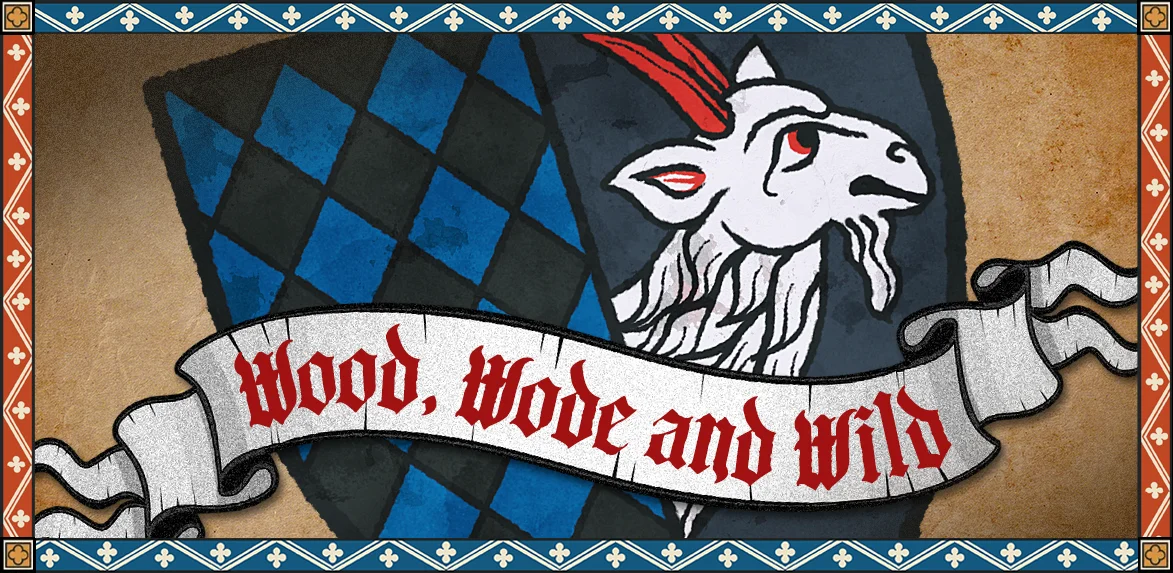
House Brackenwold: “Wood, Wold and Wild”
(Silva, Campus et Terra Effera)
The traditional words of the dukes of Brackenwold. They name the three spheres of the house’s power and ambition: Dolmenwood’s forest (Wood), the southern heartland of the duchy (Wold), and the northern frontier (Wild) they aim to claim and civilize. What the words do not say aloud is the price of that dominion, kept in a locked and lightless place beneath the castle.

The Human Houses
House Harrowmoor: “Vigilance Never Sleeps”
(Vigilantia Numquam Dormit)
House Harrowmoor is all about law, learning, and piety. Lady Theatrice is ever watchful while her less civic-minded peers are off dreaming or partying. The motto is both a creed and a sharp rebuke to anyone who might be asleep at the wheel —especially feckless neighbours like:

House Guillefer: “In Dreams, Wisdom”
(In Somniis Sapientia)
The nobles of the Hall of Sleep are famous for slumbering through the centuries, wandering fairy dreamlands while their villages quietly atrophy. Their house words cleverly reframe their vice as virtue. What remains unsaid is that the dreamlands are not empty, and that no Guillefer can be quite sure the lord who wakes is the same one who lay down.

House Mulbreck: “Deeper Than It Appears”
(Altius Quam Videtur)
House Mulbreck used to be respectable, but now it’s rotting from the inside out. At first glance, their house words sound like a boast about hidden depth and old wisdom. In the damp halls of Bogwitt Manor, however, it’s more like a glimpse of just how deep the rot truly goes.

House Hogwarsh: “Glory and Gryphon”
(Ars et Vinum)
The griffons of High-Hankle are the house’s pride and the beast of its motto, though they don’t ride on a shield. The arms show a spear-pierced boar (oddly) straddling a harp, the kill above the music. Hogwarsh once bred its griffons for war and was the terror of the barony; these days the Baron would sooner host a tourney than fight in one.

House Nodlock: “Whither the Fates Carry Us”
(Quo Fata Ferunt)
Lord Harald Nodlock has never seen a battlefield and only survives because being Lord Ramius’s lackey is a little safer than getting stomped by Lord Murkin. The motto is way older than his cowardice — an old, fatalistic creed from braver ancestors. These days, it’s less a noble resignation and more of an excuse. This house has stopped steering and is just drifting wherever the longhorns push them.

The Longhorn Houses
House Ramius: “The Eye Sees, Time Collects”
(Oculus Videt, Tempus Colligit)
The words nod to the house sigil, the Thorned Eye: Ramius watches, forgets nothing, and keeps its wrongs the way a ledger keeps debts — settled by time, not temper. The current lord, cheated of his inheritance twenty-two years ago, fits them almost too well, but they are far older than him and will outlast him.

House Malbleat: “Same Root, Better Fruit”
(Eadem Radice, Fructus Melior)
Malbleat is the one house that knows exactly how old its words are. It broke from the senior line twenty-two years ago, still pressing its claim to be the true head of House Ramius. The motto is that claim writ large — a sharp barb every longhorn in the High Wold gets, and one that really gets Ramius’ goat. (Sorry, not sorry.)

House Murkin: “The Enemy Sharpens Me”
(Inimicus Acuit Me)
The words are a warrior’s boast, but Lord Murkin takes them somewhere colder. Half-breggle, half-human and scorned by both kindreds, he treats his late father’s mild reputation as a stain to scour away, and keeps his own mother in a dungeon for contradicting him once too often. These days the “enemy” is mostly anyone who mistakes him for soft.

Lesser Houses
Brackenwold is packed with lesser noble families besides the big names. Here are some house words for these families, pulled from the rolls of human and breggle noble family names (see DCB, p. 58 and 64, respectively), but admittedly rather arbitrary. Change them as needed to suit your campaign.
Human
- House Albrime: “First to Frost, Last to Fall” (Primi Pruinae, Ultimi Casu): A hardy old house that wears the rime as a badge of endurance, never once broken by hard winters.
- House Baldericke: “Girded in Faith” (Fide Cincti): A pious house that holds itself the sword-arm of the Church, its knights girded as much in faith as in steel. Where the name once meant only the belt that bears the blade, the words now bind the house to the One True God
- House Elfwit: “Clever as Any Fairy” (Astutus ut Faia): A house that has dealt with fey-folk often enough to dare measure its wits against them.
- House Flechette: “Loosed and True” (Emissa et Vera): Founded by a legendary archer, this ancient house uses the bow as its symbol.
- House Haeroth: “Old Blood Runs Slow” (Sanguis Vetus Tarde Fluit): A dwindling line clinging to the faded grandeur of better days.
- House Highgrime: “Clean Hands Build Nothing” (Manus Mundae Nihil Aedificant): A house that prizes honest labor and scorns the idle gentry who mistake soft hands for breeding.
- House Ladrigham: “We Hold the Ledger” (Rationes Tenemus): Long charged with stewardship, and said to remember every favor and every debt.
- House Offcester: “Far From the Hearth, Faithful Still” (Procul Foco, Fideles): Defined by long, lonely service, holding to its oaths far from home and comfort.
- House Snape: “We Thrive on Less” (Minore Crescimus): Risen from grudging ground, reckoning hardiness a virtue and eyeing softer, richer houses askance.
- House Symeswitt: “Wit Wins the Day” (Ingenium Vincit): A clever, slippery family that prefers cunning to steel.
- House Twinsor: “Two Halves, One Whole” (Duae Partes, Unum Totum): A house that holds opposites in balance — mercy and law, sword and word — and reckons wisdom the giving of each its due.
- House Underlow: “Deeper Than the Roots” (Altius Radicibus): An old house whose holdings run downward into mine, cellar, and barrow — and who hold that the best things are always buried, along with a few of the worst, and that the family knows the difference.
- House Waldermost: “Faithful to the Wood” (Silvae Fideles): An ancient house whose first loyalty is to the forest itself, and whose oaths are sworn to something older than the Church — a devotion the pious eye warily, and the wise do not follow into the trees after dark.
- House Woldeleigh: “We Keep the Clearing” (Lucum Tenemus): Holders of the rare open ground, waging the endless work of keeping the forest from closing over it.
Longhorn
- House Barbicant: “None Pass the Gate” (Portam Nemo Transit): Founded by a famed castellan, holding defense and the keeping of gates as its proudest charge.
- House Canticreed: “We Sing What We Believe” (Quod Credimus, Canimus): A house famous for the fervour of its worshipful singing — though what a Canticreed sings behind closed doors, to the old ancestor-goddess, is another matter. The words promise only that the house believes what it sings in private, not what it performs in public.
- House Cllern: “We Outlast” (Permanemus): A house whose name is said to mean endurance, trusting patience to see off any rival in the end.
- House Cornicus: “By the Curl of the Horn” (Per Flexum Cornu): A traditional longhorn family, proud of its noble bearing.
- House Furroughby: “Plowed Deep, Sown Deeper” (Alte Aratum, Altius Satum): A rural breggle family of farmers risen to minor gentry.
- House Hoblewort: “Small Root, Deep Hold” (Parva Radix, Altus Tenor): A minor breggle house that clings tenaciously to its modest holdings.
- House Houndswort: “We Run Down Our Prey” (Quod Sequimur, Capimus): Descended from a celebrated Master of Hounds, with a reputation for relentless pursuit.
- House Hraiglent: “Of Hraigl’s Blood” (Sanguine Hraigl): A proud house tracing its founding to one of the seven kids of Hraigl, and never letting anyone forget it.
- House Llhraigl: “Her Defiance Endures” (Eius Contumacia Perstat): Keeper of Hraigl’s defiant spirit, bound by tradition to the ancient grudge against the Drune.
- House Lockehorn: “Our Horns Lock, They Do Not Break” (Cornua Nectimus, Non Frangimus): A stubborn line that prides itself on never yielding.
- House Lockelope: “Once Started, Unstopping” (Coepta Non Sistunt): A house of headlong momentum: once set upon a course, it cannot be checked or turned aside.
- House Overlocke: “We Watch the Passes” (Fauces Custodimus): Entrusted in its founder’s day with watch over the narrow ways, and vigilant ever since.
- House Pellicorn: “Thick of Skin, Long of Horn” (Pelle Dura, Cornu Longo): A house holding that a thick hide turns aside insult as a long horn turns aside a rival.
- House Shankhollow: “The Hollow Forgets Nothing” (Vallis Nihil Obliviscitur): An ancient house of long memory, keeping grudges and debts across generations.
- House Snidebleat: “We Bleat Last and Loudest” (Ultimi Balamus, Maxime): A petty, scheming house with a talent for outlasting its betters.
- House Wealdleap: “Sure of Foot, Sure of Word” (Pede Certo, Verbo Certo): A nimble, dependable house trusted to keep its footing where others falter.
- House Wealdlore: “The Old Songs Are Ours” (Nostra Sunt Carmina Vetera): Founded by a renowned loremaster, keepers ever after of the old songs and ancient verse.
Knightly Mottos and Personal Identity
Mottos aren’t just for houses. In both history and fantasy, knights can have personal mottos, too. A knightly motto usually shows off a personal code, a private vow, or some defining moment. Sometimes it lines up with the family motto, sometimes it adds to it, and sometimes it flat-out contradicts it.
That’s what makes mottos so handy in roleplaying games. A character might inherit a house word but pick a personal motto that actually fits who they are. Maybe the dutiful heir is stuck with “Thorn and Oath” but secretly lives by “I Will Not Bend.” Maybe a grim knight comes from a hopeful house but carries a much darker personal creed. Those contrasts are what make characters stick in your memory.
Punny Mottos
Punny mottos have their place, too. A clever or funny motto makes a house easier to remember and a lot of fun at the table. The trick is to keep the joke grounded in the world. Even if it gets a smile, a punny motto should still sound like something a noble family would actually use.
That works especially well in whimsical or folkloric settings like Dolmenwood. A punny motto can show a family’s wit, self-awareness, or a long tradition of wordplay. It also makes a house stand out right away, no long explanation needed. In a campaign or story, that kind of memorability is pure gold. Some examples:
- No Kidding
- No Crook in Our Horn
- The Wyrm Turns
- We Know the Ley of the Land
- Wight Makes Right
- Cast in a Different Mould
Try The Motto Generator
Every noble house in the Dolmenwood Campaign Book now has house words, as proposed above. If you want to go further — making up new noble houses or want personal mottos for your own knights — our free Dolmenwood Motto Generator can do the heavy lifting.
This piece owes a real debt to reader xaturo, whose sharp-eyed insights after it first went up reshaped a good deal of it. The houses are better for it.
See You in the Lists!
Knights of the Wood: The Duke’s Tourney contains complete rules for jousting, sorcery competitions, feasting, dancing, and everything else you could possibly need to run tournaments in Dolmenwood. Need to generate knightly competitors? Check out our free Dolmenwood Knight Generator.

All heraldic illustrations on this page are original artwork by Brian Abshier for Press Perilous, based on the official noble house designs from the Dolmenwood campaign setting, © Necrotic Gnome. Used with permission.


Leave a Reply