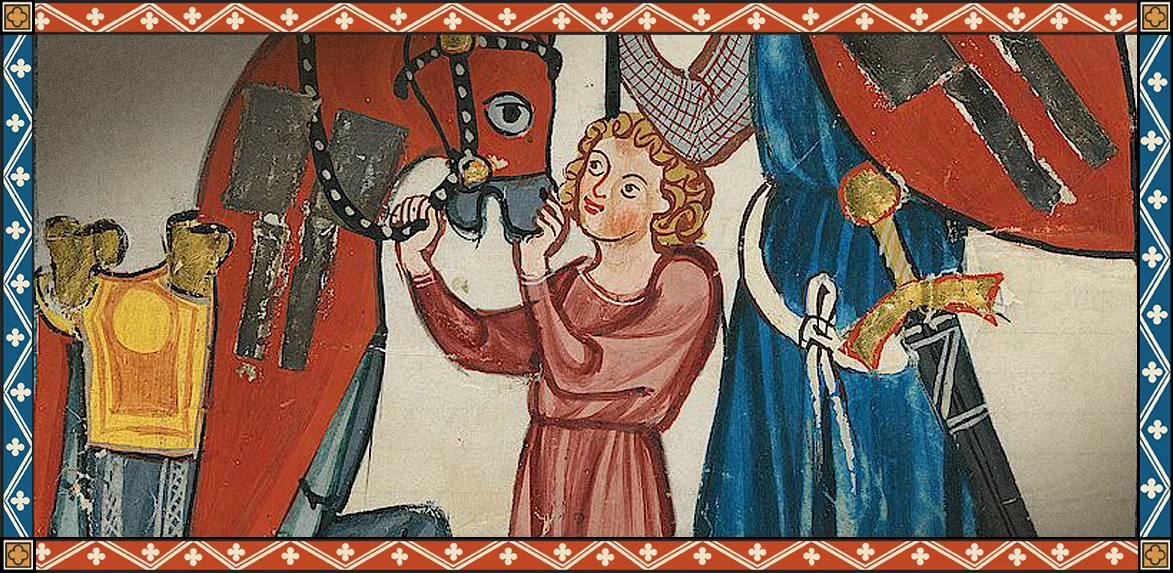
This is the first in a series of articles on the Dolmenwood Knight class. We start at the bottom rung, with the Squire, and work our way up. Next time, in “What Is a Knight?”, we’ll look at the three kinds of knights who ride through the Wood and how each of them pays their way.
Every Knight in Dolmenwood starts out as a Squire. The Knight class in the Dolmenwood Player’s Book says so plainly: at Level 1 and 2 you’re a Squire, and only at Level 3 do you get to call yourself Sir. We like that. It makes the early levels feel like an apprenticeship, and players remember the day they’re knighted.
Then a player asks the obvious question. If I’m a squire, whose squire am I? And why is my knight letting me wander off into the Wood with a friar and a thief?
Erm…
Whose Squire?
The books give us a start. The Dolmenwood Player’s Book says a Knight serves one of the lower noble houses of Dolmenwood, rolled or chosen at character creation. It also says PC Knights are typically knights-errant, wandering in search of adventure and a chance to show their chivalry. Put those two lines side by side, and something doesn’t add up. A knight in a noble house’s service lives at their lord’s beck and call, eating in the hall, serving in the garrison, escorting his liege, and riding out to war when summoned. By contrast, a knight-errant goes wherever adventure leads them, usually with a ragtag bunch of adventurers in tow, and can be gone for weeks.
So how can a Knight be both? And if they are, does the liege pay their way, and what do they expect in return? Some Referees would rather not answer those questions on the fly. Lucky for them, we’ve done the work. So here’s how squiring works in our Dolmenwood, and how we square it with a Knight who spends their days poking around barrow mounds and ruined abbeys.
A Squire’s Lot
In our Dolmenwood, squiring follows the old real-world custom. A young noble enters a knight’s service at about 14, usually in a household other than their own, often an uncle’s or some other kinsman’s. Raised away from home, a squire gets no special favors on account of their parents. Bringing up another family’s child is a weighty trust, and done well, it strengthens ties between them for a generation. Service typically ends at or around age 21, when the squire comes of age to be dubbed.
The bargain runs both ways. The squire looks after their knight on the road and in the field, and the knight turns the squire into someone fit to carry a lance and dine at a lord’s table.
At home, the squire scours rust from mail, sharpens blades, and polishes helms. At dinner, they carve the roast and keep their knight’s cup filled. They see to the horses and help their knight armor up. On the battlefield, the work gets a good deal more dangerous. A squire brings up a fresh horse when the first one goes down, carries spare lances, guards prisoners, and even drags their knight out of the press when things go badly.
Noble birth is the usual path to knighthood, but there’s another. The Dolmenwood Player’s Book allows that a commoner can earn a knighthood through some great deed. In our Dolmenwood, that road runs through squirehood too. A commoner who drags a lord’s heir out of a burning hall, or holds a ford after the household knights have fled, may be taken into the house’s service as a squire, often well past 14. Their fellow squires seldom let them forget where they came from.

Twenty-One and Still a Squire
Turning 21 makes a squire eligible for knighthood, but someone still has to pay for it. A knight needs a warhorse, a riding horse, armor, weapons, and a squire of their own, and all of it has to be kept up year after year. In a Wood where hardly anyone below the great lords holds land, that nearly always means a lord willing to foot the bill, and a lord can only feed so many knights.
Squires lacking a lord to sponsor them make what they can of themselves. Some sell their swords to a lord’s garrison, and others put their courtly schooling to work running somebody’s household. The rest take to the road with a sword and a horse, seeking fame, fortune and someone willing to knight them.
The Trouble With “Squire”
The first snag is age. By the Dolmenwood Player’s Book, a human Knight starts play at 15 + 2d10 years, so anywhere from 17 to 35. A 17-year-old Squire should still be in a knight’s service, polishing someone else’s mail. A 30-year-old one has been out of service for years and has never been dubbed, which is plausible enough but needs some explaining.
Then there’s the word itself, which Dolmenwood uses in two ways. In the Campaign Book, the five knights of Fort Vulgar are attended by squires, and those are young noblemen in the service of a knight. That said, a Level 1 Knight is also called a Squire. But a squire in service to a knight isn’t free to wander off with a party of adventurers for weeks at a time. Their knight would have something to say about that.
Household service doesn’t help either. A household knight lives in their lord’s castle, eats (and often sleeps) in the great hall, and answers when called, which leaves little time for crawling through the Wood with a hunter and a magician.
So the default PC Knight is a squire with no knight, sworn to a house, and sent off as a knight-errant, and the nature of that arrangement is left to the Referee to sort out.
Sent Out at Twenty-One
At our table, every PC Knight starts at about 21, freshly released from their knight’s service. They still belong to the house the player rolled or chose, which is the house they grew up in or, for a lowborn Knight, the one that took them in. They wear its colors and owe it their sword in time of need. But the household has no seat for them yet, since places in the hall are few and rarely open. So the house sends its spare Squires out as knights-errant, just as the Player’s Book suggests, to prove themselves and make themselves useful.
To make the dice agree, roll 19 + 1d6 for a human Knight’s starting age instead of 15 + 2d10. That gives a range of 20 to 25, with the odd Squire sent out a year early.
Now the PC is a Squire by title but serves no knight, so they’re free to go wherever the adventure leads, as long as they come when the lord calls. It also gives them a reason to go. A Squire’s horse, armor, and taste for the finer things don’t pay for themselves, and a good haul from a forgotten crypt beats begging at a castle gate.
Serving From the Saddle
A Squire who’s sworn to a house but sleeps under hedgerows raises some fair questions. Here’s how we answer them.
Why the lord lets them go: Knight-errantry is a time-honored custom in Dolmenwood, some would say a rite of passage. A Squire showing their chivalry on the road reflects well on the house that raised them. It also costs the house nothing. They win renown under the house’s colors and keep their sword arm strong for the day the house needs it. A lord with more Squires than seats at table would rather have them out earning their keep than idling in the hall.
What the lord gets: Errands, mostly, the kind a lord would rather not spend a household knight on: carrying a letter through bandit country, say, or looking into rumors on the house’s borders. The Squire’s companions come along, and the lord doesn’t much mind who helps, so long as the job gets done.
Who pays the upkeep: The Squire does. Their horse, armor, and small comforts all come out of what they win in crypts and in the lists. The house may stand them a meal and a bed when they pass through (as will other noble houses according to the custom of hospitality), but it pays no stipend, which is a good part of why Squires go adventuring at all.
When the house calls: They answer. A summons might bring a Squire home to swell the lord’s retinue at a wedding or to join the muster when crookhorns come raiding. Ignoring it costs them standing, and a Squire who ignores it more than once may find the lord has stopped calling. At that point, they’re truly a hedge knight.
Errands From the House
When a noble house has work for a Squire, roll a d10. Every errand has a wrinkle the lord didn’t mention.
| d10 | The Errand |
| 1 | Carry a sealed letter to a rival house and bring back the reply. The rival’s steward insists the Squire stay for supper. |
| 2 | Escort the lord’s chaplain to a hermitage deep in the Wood. The chaplain won’t say why he’s going. |
| 3 | Find out who’s been poaching the lord’s deer. The tracks lead somewhere no poacher should go. |
| 4 | Fetch a betrothal gift from a craftsman two towns over, who swears it’s already been collected. |
| 5 | Ride the house’s borders and report on a boundary stone nobody remembers setting. |
| 6 | Collect overdue rents from a tenant village. They say they already paid, to a knight in the house’s colors. |
| 7 | Stand as the lord’s champion in a petty dispute settled by combat. The other side’s champion isn’t petty at all. |
| 8 | Bring home a young cousin who ran off with a troupe of mummers and has no wish to come back. |
| 9 | Look into a fairy road that has crossed the lord’s lands every night since the last full moon. |
| 10 | Buy back a family heirloom the lord’s son pawned, quietly. The lord doesn’t want the son to know he knows. |

Where It Leads
Knighthood comes first, at Level 3, when someone finally dubs the Squire. Any knight can do the dubbing, though the grander the hand on the sword, the more the honor is worth. Who does the deed is best left to play. It might be the lord of your own house, once you’ve earned it. Or it might be the champion you impressed in the lists, or the old knight who turned you out at 21 and has since thought better of it.
Who Dubs You?
If nobody at the table has a better idea, roll a d6.
| d6 | The Knighting |
| 1 | The lord of your house, in the great hall, before the whole household. |
| 2 | A household knight of your house, on the field, moments before a fight you might not survive. |
| 3 | A tourney champion, impressed by how well you rode against them. |
| 4 | A visiting lord of another house, which pleases your own lord less than you’d hope. |
| 5 | The old knight you once squired for, who turned up to see how you’d turned out. |
| 6 | The Duke himself, at Castle Brackenwold. Your lord is very proud and a little nervous. |
A newly dubbed knight still rides out on the house’s errands until a seat opens in the household, and when one does, the house looks first to those who’ve served it well on the road. Taking that seat brings security, though from then on the lord picks the knight’s adventures. For a character ready to settle down, it’s a fine retirement.
One Squire’s Road
Here’s how it plays at our table. A player rolls a human Knight sworn to House Harrowmoor and starts him at 22, freshly released from service to his uncle, one of Sir Osric’s knights at Fort Vulgar. His name is Wynne. There’s no seat for him at Harrowmoor Keep, so Lady Harrowmoor sends him out with her blessing and his first errand: find out who’s been stealing sheep from the hill farms on Harrowmoor’s border.
Here’s how it plays at our table. A player rolls up Wynne, a human Knight sworn to House Harrowmoor, and starts him at age 22. Wynne is freshly released from service to his uncle, Sir Hadrian of The Vulgar Knights. There’s no seat for him at Harrowmoor Keep, so Lady Harrowmoor sends him out with her blessing and his first errand. The house has long sent bread and lamp oil to the hermit who keeps the little shrine to St Vinicus, above the Valley of Wise Beasts. This month the carter came back with the last basket still full, refusing to say what he saw. Lady Harrowmoor wants to know why.
The Hermitage
Wynne doesn’t know the way, so at Prigwort he finds people who do. A taciturn hunter who works the cliffs above the Valley agrees to guide him for a share of whatever turns up. A friar who took vows alongside the hermit insists on coming to see about his old friend. A spot on the Swinney Road near Sinkhole Creek is littered with felled trunks, and the hunter points out cloven hoof prints among them. Crookhorns. A Shubber patrol has recently been probing Harrowmoor’s western flank.
At the Hermitage, the party finds the hermit’s head sitting on the peak of his roof, and a mogglewomp filling the hut. With the help of cold iron, the party defeats the wretched creature, taking only minor hurts themselves.
In the hermit’s things, they find antique prayer books, the shrine key, and a map of Lake Longmere. A note in red marks a “lost shrine to Saint Galaunt” on the southwestern shore. The three companions bury the hermit.
Answering the Summons
Back at the keep, Wynne reports on the hermit’s fate and turns over the key and the map to Lady Harrowmoor. He also reports the crookhorn sign on the cliff path. The Lady buys the hermit’s books for her library; the coin will keep Wynne and his horse well-fed through the winter.
The Lady calls him home twice. In spring, a crookhorn band comes up out of the Valley along the cliff path. Thanks to Wynne’s report, Harrowmoor’s soldiers are waiting for them, and Wynne takes an honorary place in the van. The second summons is to a feast, which he rather enjoys until he finds himself seated below the salt.
How Many Squires?
The Dolmenwood Monster Book (p. 106) is generous with squires. It gives Level 1 and 2 Knights none, which makes sense, since technically they’re squires themselves. But even a newly dubbed Level 3 armiger comes with 1d4 squires, and a Level 5 knight rides with 1d4 armigers and 2d4 squires. An unlucky roll could put one armiger and eight squires on the road behind a single knight. That’s more retinue than most knights in the Wood could ever feed.
One Squire per Knight
Every squire is another young noble to clothe, mount, arm, and train. A household knight living on their lord’s purse can’t keep a crowd of them. A wealthy landed knight might, and so might a hedge knight flush from their last crypt and careless with coin. For everyone else, we recommend one squire per knight. A Level 5 knight leading a company can stretch to two, while each knight riding with them keeps one of their own. A gallant with two squires and an armiger or two with one apiece is a far likelier sight than a small army.
Before Level 3
Squireless knights at Levels 1 and 2 still need somebody to tie their arming points and hand them a lance in the lists. A hired servant will do, or a party member willing to lend a hand.
When a PC reaches Level 3, they acquire their own squire in one of two ways. The house may hand the new knight one along with the accolade, usually a youngster from a friendly family, and now the knight has someone of their own to train and keep alive. We recommend just using the Everyday Mortal stat block for these. Or the knight finds and pays for a squire themselves, which means one more mouth to feed from their own purse while going about their errantry.
Either way, give the knighting a proper scene. Whether the PC kneels in the mud of a battlefield or before a cheering crowd at the lists, let somebody important lay a blade on their shoulder.
Join us next time for “What Is a Knight?”, the second article in our series on the Dolmenwood Knight class. We leave the squires behind and follow the knights themselves, from Sir Osric’s retinue at Fort Vulgar to the hedge knights who answer to nobody.
How do squires work at your table? Tell us in the comments below.
See you in the lists!



Leave a Reply