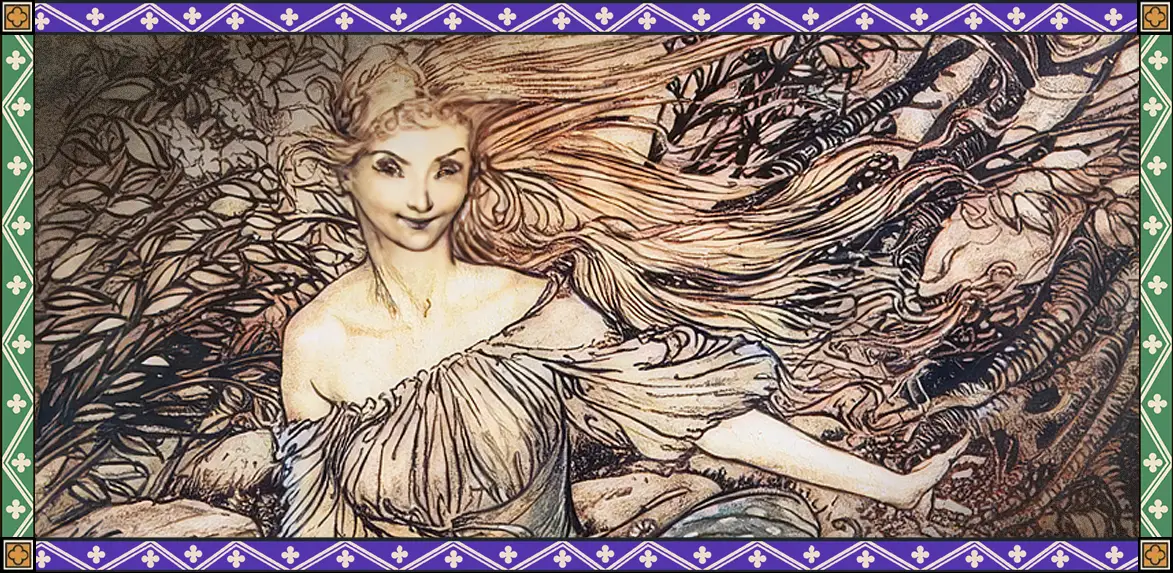
Part IV of Vows, Oaths, and Geasa
This is a bonus installment in our series on what happens when Dolmenwood knights make—and break—promises. Part One revisited the Vow of the Peacock, Part Two covered Saintly Oaths, and Part Three introduced fairy geasa. This time, we visit the courts that seldom deal with mortals at all.
We said Part III would be the last word on geasa. Turns out our ten fairy geasa drew more readers than anything else we’ve posted, and a good many of you asked the obvious question: what about the rest of the fairy nobles?
The Dolmenwood Campaign Book details many fairy nobles, and most had a good reason to sit out the first round: they rarely deal with mortals. One rules a lightless realm and imprisons anyone who wanders in. One has faded into the countryside around Lankshorn and no longer has a body. One is an exile whose lands swallow nearly everyone who enters them.
That’s what makes them interesting. The Cold Prince wants agents in the mortal world, so a geas from him is business as usual. When the Blind King lays one on a knight, something strange has happened, and the geas carries the story of how it happened.
Far Courts and Faded Kings
In Part III, we described four ways a geas finds a knight: a bargain, a trespass, a gift or a birthright. The six nobles below each favor one or two of those, and some of them almost never hand out geasa at all. So each entry opens with a note on how a knight comes by it. Treat these as suggestions. If your table has a better story for how a knight ended up bound to the Regent of Tallowspire, use it.
Making Amends, Briefly
Everything in Part III’s Making Amends section still applies. A knight who breaks a Prohibition loses the Power and suffers the consequence, which lasts until they plead their case with the fairy and make a Reaction Roll. On a 9–11, the fairy names a price, and each entry below suggests one. Until the knight pays it, the consequence stands. A fairy forgives twice, the second time at -2. The third time, the Power is gone for good.
Several of these nobles make that trip far more dangerous than a visit to Spoondrift Castle. That’s deliberate. A knight who has to walk back into Gloomhold to say sorry has a choice to make, and choices are where the stories are.
Six More Fairy Geasa
Choose a geas that suits the noble and the situation, or roll a d6. The same warning applies as before: most of these Prohibitions are easy to keep until the day they aren’t.
1. Blind King’s Echo
How It Finds You: The Blind King has no dealings with Dolmenwood and imprisons any mortal who trespasses in Gloomhold. Very rarely, he lets one go. No one knows why, and the ones he releases can’t tell you, since the dungeons of Absolom took their memory of light along with everything else.
Power: In darkness, you’re never blind. You sense everything within 30 feet by its echoes, and you can move and fight in total darkness as if it were lit. The King sends you home with a little of his sight, and a little of his dark.
Prohibition: You may never carry a light. Your companions can light the way, but no torch, lantern, or candle may be in your hand. The King doesn’t care for anything that might outshine him.
Breaking the Prohibition: The darkness of Absolom seeps into your mind, and you begin to forget what light looks like. Torches and lanterns no longer help you see, and anywhere daylight doesn’t reach, you suffer -2 on Attack Rolls. This lasts until you make amends with the King in Gloomhold, or through one of his blind servants. On a 9–11, his price is seven days and seven nights in the dungeons of Absolom, though with no dawn to count by, you’ll have to take his word for it. When you return, roll on the Time Passed in the Mortal World table (Dolmenwood Campaign Book, p. 26) to learn how long you were really gone.
2. Thorn-Rosy’s Gilding
How It Finds You: Mortals can’t visit the Baths of Astralon as guests, but they can work there as maids and furnace-tenders, and adventurers sometimes win an audience with one of the eminent bathers. Thorn-Rosy has little use for rank and a soft spot for ambition. A knight who reaches above their station within her sight may leave with a geas.
Power: Once per day, you may wrap yourself in a glamour of rank for an hour. Your clothes look finer, your bearing grander, and mortals take you for someone well above your station. Fairies see straight through it and admire the audacity. Either way, you gain +1 on Reaction Rolls while it lasts.
Prohibition: Whenever you ford running water or bathe in it, you must drop a gold piece into it. Consider it the bath-house fee. Bridges don’t count, though her true favorites avoid them anyway. Every ford is a chance to show her what they think she’s worth.
Breaking the Prohibition: The gilding wears through, and her glamour turns against you. To mortal eyes, you look like what you really are, or worse: a sooty furnace-tender in borrowed armor. You suffer -2 on Reaction Rolls with mortals. This lasts until you make amends with Thorn-Rosy, which means finding the Baths of Astralon when they next appear beside a mortal pool or river. On a 9–11, her price is a week stoking her furnaces, unpaid.
3. King Pusskin’s By-law
How It Finds You: King Pusskin abandoned Fairy centuries ago and has faded into the High Wold around Lankshorn, with no body left to speak of. His geasa come from living under his by-laws. A knight who keeps them long enough, and well enough, may find the King has taken notice.
Power: Once per day, you may fade from notice the way the King has. For up to a turn, mortals and animals overlook you as long as you don’t attack, speak or touch anyone. Fairies notice you, and they find it a little sad.
Prohibition: You must never close a door behind you. Every door you pass through stays ajar, as any cat would insist. It’s one of the oldest by-laws of the High Wold, and the King expects his favorites to keep it wherever they go.
Breaking the Prohibition: The King’s wrath comes as a thousand small spites. Latches slip, bars lift, and no lock you fasten stays fastened for more than an hour. This lasts until you make amends with the King, who has no hall to visit. You plead your case aloud anywhere in the High Wold, and he hears. On a 9–11, his price is to be remembered: you must tell his tale at every inn you stay at for a month.
4. Devotion of the Lady of Spring Unending
How It Finds You: Plenty of mortals wander into the Death Glades hoping to glimpse the most beautiful woman in Dolmenwood. Few are seen again. The ones who come back out are bound to her.
Power: You always know when food or drink has been poisoned. To you, it smells faintly of blossom. You also gain +2 on saves against poison. The Lady knows her poisons, and she doesn’t care to lose a devotee to someone else’s.
Prohibition: You may never praise the beauty of anyone but the Lady, and you may never wear another’s favor in the lists. Your heart is spoken for, whether you like it or not.
Breaking the Prohibition: A sweetness lingers on your tongue, and her poison works through you. Each morning, Save Versus Doom or suffer -2 on all rolls that day. This lasts until you make amends with the Lady in her ever-blossoming glades, and she keeps no servants to carry your apology. On a 9–11, her price is a single flower from the Blossom Fields, picked from her sister’s garden.
5. Languor of the Prince Who Is Seven
How It Finds You: The seventh, solitary form of the Prince needs hands in the mortal world to dig up lore of the First King of Lampwrack. A knight who strikes a bargain with him gets this geas as part of the terms. Now and then, one who stumbles into the endless ball at Harkthold leaves with it as a party favor.
Power: Once per day, when an attack would hit you, you may make the attacker reroll it. For an instant there are seven of you, and the blow has to find the right one.
Prohibition: Every seventh day, you must spend from dawn to dusk in idleness and revelry, as his court does. You may defend yourself if attacked, but nothing more: no travel, no work, no fighting you start yourself. The Prince’s court has kept this pace for centuries, and he sees no reason his favorites should hurry.
Breaking the Prohibition: The court’s weariness settles on you, and part of you stops caring what happens. You suffer -2 on all saves. This lasts until you make amends with the Prince in Harkthold, and you must find the right one. The six at the ball will forgive you anything and remember none of it. Only the seventh, alone in his forgotten tower, can lift it. On a 9–11, his price is a scrap of lore about the First King of Lampwrack.
6. Eye of the Regent Hador
How It Finds You: Hador collects people of taste as readily as objects. A knight who brings something exquisite to the Palace of Sighs, or simply shows a good eye while there, may leave with this geas as a compliment.
Power: Any object you hold for a turn tells you its true worth in coin, whether it’s magical, and where it was made. Hador has no patience for a collector who can’t tell a treasure from a trinket.
Prohibition: Once a beautiful thing is yours, you may never part with it. You can’t sell it, trade it, give it away or leave it behind. What counts as beautiful is the Referee’s call, though your eye will usually tell you. A true collector doesn’t let go.
Breaking the Prohibition: Beauty flees from you. Gilt flakes, gems cloud and silk frays in your hands, and any treasure you sell fetches only half its value. This lasts until you make amends with Hador in the Palace of Sighs, somewhere in a city that never ends. On a 9–11, his price is your reflection, to hang in his vaults. Mirrors and still water never show you again.
When Geasa Collide
In Part III, we warned about the knight who owes both Duke Mai-Fleur and Princess Andromethia and hears the horns at the edge of a barley field. These six add new ways to get caught between two courts.
A knight devoted to the Lady of Spring Unending who also enjoys the Bounty of Princess Andromethia is standing in the middle of a family feud, and the Lady’s price is a flower stolen from her sister’s garden. A knight with the Prince’s Languor will one day spend an idle seventh day listening to Mai-Fleur’s horns, with no good way to obey both. And a knight with Hador’s Eye can never hand over a beautiful thing, which makes paying any other fairy’s price in treasure an awkward business.
That’s the old lesson of the geas, and Cú Chulainn learned it the hard way. One obligation is a promise. Two are a trap waiting for the right moment.
Whatever you do, leave the door ajar on your way out. King Pusskin is watching.
New to the series? Start with Part I, “The Vow of the Peacock, Redux,” then Part II, “Saintly Oaths: A Chance to Show Your Quality,” and Part III, “Fairy Geasa: The Gift Chooses You.”
Is there a fairy noble you think deserves a geas of their own? Tell us in the comments below, and share your own if you’ve written one.
See you in the lists!


Leave a Reply