Part II of Vows, Oaths, and Geasa
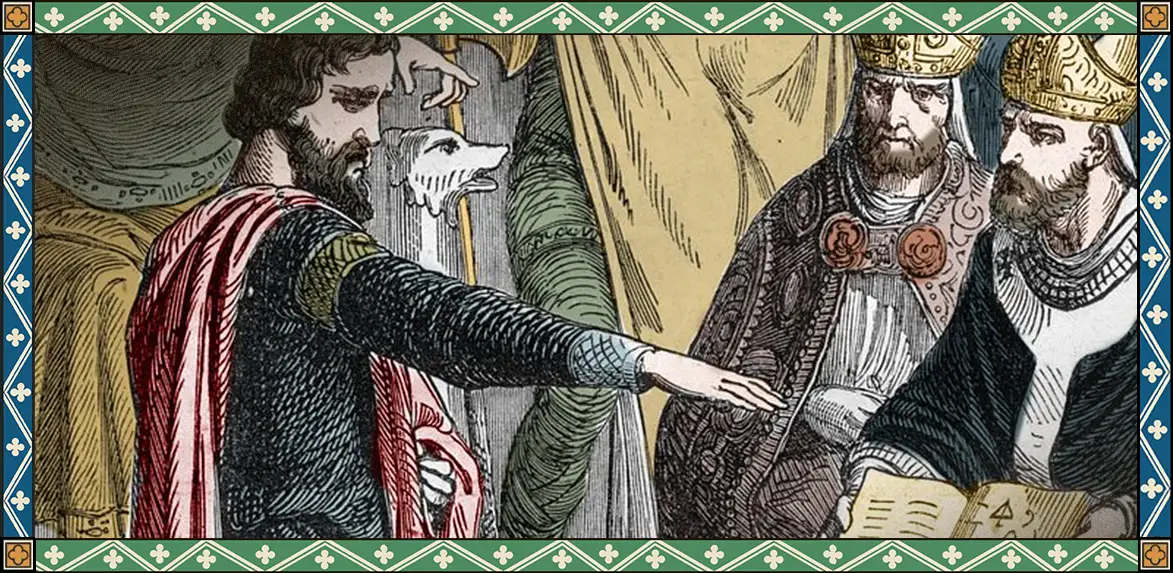
Welcome to part two of our deep dive into what makes Dolmenwood knights shine. If you caught Part One, you know about the Vow of the Peacock—a public promise to go do a specific deed. This time, we’re digging into Saintly Oaths. They aren’t about what you’ll do. They’re about who you are.
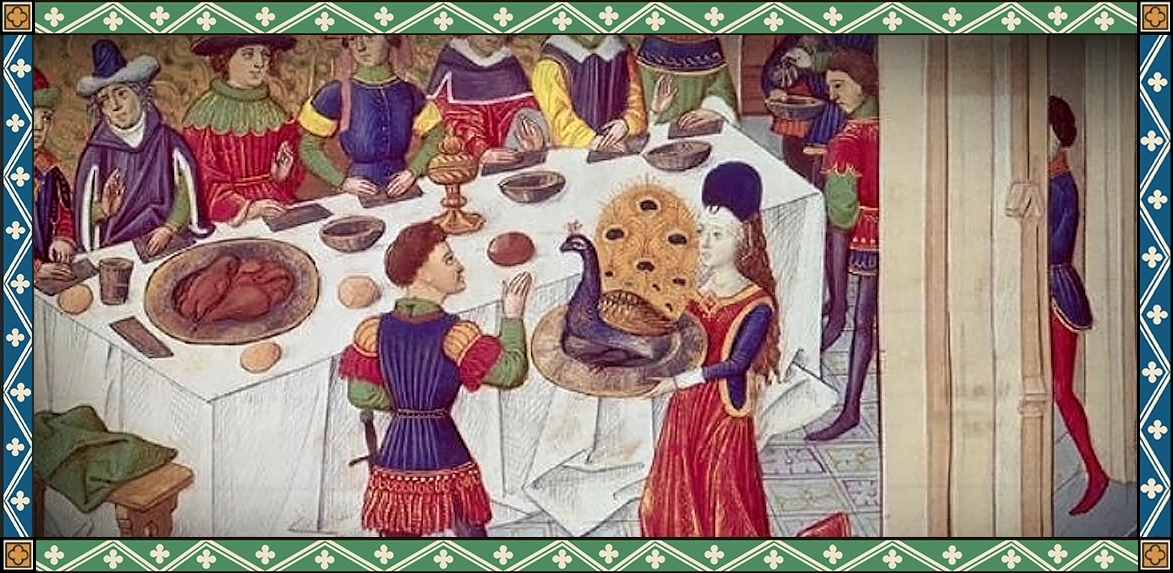
THE VOW OF THE PEACOCK is all about a single deed. You do it, you’re done. Saintly oaths work differently.
A saintly oath is a standing claim about your character. It’s the difference between swearing to rescue Lady Lisabeth by the Feast of St Whittery and swearing you’ll never strike a helpless foe as long as you live. There’s no end line.
It’s the difference between swearing to rescue Lady Lisabeth by the Feast of St Whittery and swearing you’ll never strike a helpless foe as long as you live.
It sticks with you every session, and it’ll get tested. Sometimes your Referee does that on purpose. More often, the world does it for him, because the world is messy and codes of conduct are anything but.
Readers familiar with the Code of Chivalry (see Dolmenwood Player’s Book, p. 17) can feel the saints moving around behind it, though the Code doesn’t name them. Gondyw is all about Glory. Quister loves Service. Thridgold demands the Protection of the Weak. That’s on purpose. The Code asks these things of every knight in broad strokes. A saintly oath takes one saint’s whole deal, narrows it to a single line you won’t cross, and swears it out loud with that saint standing surety. Keeping the Code is table stakes. An oath puts something supernatural on the table. It’s next-level swearing.
What You Already Owe
A knight already carries two obligations before any of this comes up. (Most knights, anyway; hedge knights may be an exception.)
First, there’s Homage: You kneel, you put your hands between your lord’s, you name yourself their man, setting up a formal reciprocal relationship, which may include a grant of land (rare in Dolmenwood) or a place in his household. Fealty is homage-adjacent, but does not require it. It’s basically a pledge of loyalty. Both are worldly arrangements. Neither one has anything supernatural about it.
A saintly oath sits on top of both. It’s voluntary and permanent. No lord can require it of you. A knight can swear only one in his life. Once sworn, it can’t be transferred, replaced, or renegotiated. Choose wisely.

Swearing the Oath
An oath sworn in private isn’t a saintly oath. It’s a private resolution, which is fine as far as it goes, but it carries no weight with anyone, saints included. The Church wants several things:
A place. A consecrated altar, a shrine of the saint, or the steps of the Cathedral of St Signis are all good candidates. Out in the field? A priest and his portable altar will do. Some knights travel a good long way for the right shrine. The saints take notice.
A vigil. The night before, the knight fasts, lays his arms on the altar, and keeps watch till dawn. Many swear at their dubbing, since they’re already standing vigil anyway. Others wait years for the right saint to make himself obvious.
Referees, bend the vigil to fit your table. If your PC knight is already dubbed and three sessions in, one night in a chapel is plenty.
Witnesses. At least two people of standing who can testify to what was said. The oath is a public act. That’s what makes it binding, and it’s why breaking it costs so much.
Something to swear upon. A hand laid on the altar will do. Better is a relic: a knuckle bone in a gilt box, a scrap of the saint’s robe, a page of scripture copied in his own hand. The oath binds either way. But a man who swears on the bones of St Gondyw and then breaks faith has done a worse thing than a man who swore on plain stone, and the saints will know.
Referees, an oath sworn on relics the swearer didn’t know were there still binds. That trick cost a king of England his crown, by one account. Steal it.
A small token of your sincerity. There’s no fee per se, but the Church expects an offering — because of course it does — and it needn’t be coin. A sword laid on the altar is traditional. A candle, tall as the knight, counts for just as much. The offering is taken into the Church’s coffers. An offering worth less than 10 gp may mark you by all present as an uncharitable miser.
What the knight receives in return is a boon: the saint’s half of the bargain, a supernatural favor that holds for exactly as long as they keep faith.
An oath nobody ever has to keep is just a bonus with a saint’s name on it.
Ten Saintly Oaths
Here’s ten of them. The numbers let you roll one up for an NPC knight. Players, pick the oath that makes the best story, not the best bonus. Referees, make that choice cost something now and again. An oath nobody ever has to keep is just a bonus with a saint’s name on it.
Each entry has three parts. The Commitment is the line you won’t cross. The Boon is what the saint hands you while you hold it. The Consequence if Broken is what that particular saint does to you when you don’t, and it lands on top of the Renown loss and the forfeited boon that every broken oath carries. More on those after the list.
Dolmenwood has a hundred saints. We’ve used ten. Referees are encouraged to invent oaths for other saints, as needed.
1. The Oath of St Gondyw, Converter of Kings
Commitment: Never refuse a formal challenge to single combat from a named opponent of equal or higher rank, issued before witnesses on honorable terms.
Boon: +1 to attack and damage in formally declared single combat.
Consequence if Broken: No knight of standing (Renown Level 0 or more — see Knights of the Wood: The Duke’s Tourney p. 45) will ride alongside you or second you in any formal combat.
2. The Oath of St Faxis the Penitent
Commitment: Never shelter, conceal, or make common cause with a practitioner of dark magic: necromancers, the Drune, or those who traffic with devils. You may confront them, interrogate them, or oppose them by any means. You may not aid them.
Boon: +2 to Saving Throws against the spells, powers, and fear effects of Chaotic magic-users and their creations.
Consequence if Broken: A cloven hoof print the size of a thumbnail rises on the back of your left hand, raised and shiny like an old burn. The Church calls it “Consorts with the Unclean.” It never fades. Common folk don’t see it. Any priest of the Order knows it at a glance. Every practitioner of dark magic knows the mark, your face, and the fact that you can be bought.
3. The Oath of St Sedge the Unblemished
Commitment: Never abandon an ally who still stands and fights; never quit the field while a companion remains in danger.
Boon: Once per day, lay hands on a wounded ally to restore 1 Hit Point per level of the knight.
Consequence if Broken: No hireling or retainer will knowingly take your service again. Those already sworn to you suffer -2 to Morale Rolls, and any who watch you abandon a companion must check Morale at once or quit your service on the spot.
4. The Oath of St Signis the Silent
Commitment: Never refuse to face an undead creature when innocents are at risk, and never leave the restless dead unquieted if you have the means to quiet them.
Boon: +1 to Attack Rolls and Damage rolls against undead. If the undead can only be hit by magic or silvered weapons, your normal weapon can still hit, but the damage is halved.
Consequence if Broken: Undead in any combat encounter prioritize you above all other targets — they sense your failure and single you out.
5. The Oath of St Apoplect the Ever-Roaming
Commitment: Never refuse hospitality — including shelter, food, or meaningful aid — to a traveler genuinely in need.
Boon: +1 to all Reaction Rolls with strangers encountered on the road.
Consequence if Broken: Your reputation for turning away the needy precedes you wherever you go. -2 to all Reaction Rolls, not just with other knights and nobles.
6. The Oath of St Gwigh the Unsleeping
Commitment: Never sleep while on guard duty; always post a watch before resting, even in relative safety.
Boon: You are never surprised while on guard duty; you always act in the first round of any encounter that begins when you’re standing watch.
Consequence if Broken: At the onset of any dangerous situation, you must Save Versus Spell or fall into involuntary sleep for one round — the vigilance you abandoned turns against you.
7. The Oath of St Knock the Steadfast
Commitment: Never abandon a position you have been ordered or have sworn to hold, regardless of the odds.
Boon: +1 to Armor Class when you have not moved from your position in the current combat round.
Consequence if Broken: Your reputation for breaking under pressure follows you into every dangerous moment. -2 to all Saving Throws.
8. The Oath of St Offrid, Oath-Bearer
Commitment: Never break a sworn oath — not for a lord’s command, not for coin, not for your life.
Boon: No magic can compel you to break a sworn promise. +2 to Reaction Rolls with anyone who knows your reputation for keeping oaths.
Consequence if Broken: A spectral presence witnesses every promise you make from that day forward, plain to everyone around you, and your enemies learn the moment you break one, however small.
9. The Oath of St Quister, Ever-Loyal
Commitment: Serve one sworn lord absolutely; never publicly contradict or undermine their authority. Whatever you think of their judgment, you say it privately, and to their face.
Boon: No magic can turn you against your liege. Your liege lord also gains a Save Versus Spell against any magical compulsion that would turn him against you.
Consequence if Broken: The stigma of public disloyalty follows you. No lord of standing will accept your service.
10. The Oath of St Thridgold the Gallant
Commitment: Never refuse a direct plea for aid from a woman in genuine distress.
Boon: +1 to all rolls made in direct pursuit of a sworn rescue or protection mission undertaken on her behalf.
Consequence if Broken: Any woman in genuine distress who encounters you perceives you as a threat and calls for help against you rather than from you. This lasts until you have completed a significant act of protection at great peril to yourself, unrewarded and unsolicited.
Referees, this is the most Arthurian oath on the list and the ugliest one to break. That consequence turns half the setting into an alarm bell pointed at your knight, which is perfect for a story about a fallen champion and awful for a party trying to buy rope in Prigwort. Broaden it to “anyone defenseless” if that suits you better, and think about giving the penalty an end date.
PALADINS OF DOLMENWOOD?
Many OSR games have some version of the paladin: a knight with a code, a gift from on high, and a long fall waiting if they break faith. We love Paladins. Alas, Dolmenwood has no such class. But with saintly oaths, it might not need one. A knight with a saintly oath has all three already, and the consequence of breaking your oath is written down, so nobody at the table has to argue about it.
Pick the oath to match the paladin you want. Swear by St Signis, and you have the undead-hunter. St Faxis gives you the knight who stands against dark magic. Want the errant protector riding to answer a plea? That’s St Thridgold. And St Gondyw makes the champion who has never once refused a challenge and never will.
When the Oath Breaks
You keep the boon as long as you honor the oath. Breaking it has consequences:
- Your Renown drops to Level -2, Dishonorable, no matter where it stood that morning. Ten years of reputation, gone by supper. That’s how reputation works.
- The boon is gone for good. No penance buys it back. No saint hands it out twice.
- You pick up the specific penalty listed under your oath, which is generally worse than losing the boon was.
The Church remembers. So do the saints.
What Counts as Breaking
Saints judge intent. A knight in chains while the thing he swore to stop happens twenty feet away hasn’t broken his oath. Neither has a knight who fell for a deception, nor one who acted under a compulsion, which matters plenty, since only two of these ten oaths guard against compulsion at all.
What he’s done is fail, and failure carries its own bill. He owes a confession and a small penance at the next reasonable chance. Let it slide and the failure hardens into the real thing, all three penalties attached. Saints forgive circumstance. They’ve no patience at all for a man who can’t be bothered.
When the Oath and the Lord Disagree
A knight of St Offrid whose lord orders him to break a promise is in real trouble. So is their liege, though the lord may not know it yet.
Both obligations hold at once. Fealty doesn’t trump the oath, the oath doesn’t trump fealty, and somebody’s gonna be unhappy. The knight has three moves:
- Refuse, which is a breach of fealty and his lord’s business to punish, though a lord who punishes a man for keeping faith with a saint should expect his court to take note
- Obey, break the oath, and take the consequences of breaking the oath, or
- Find a way to accomplish the lord’s goal without breaking faith: convince the lord to quit the goal, get it handed to another knight, stall until the situation plays out more, etc. That road is perhaps the hardest, and it’s usually worth investigating.
Referees, let this cut both ways. A lord who knowingly orders a knight to break a saintly oath has sinned on his own account, and the Pluritine Church takes a dim view. That lord may find his chaplain gone chilly, his neighbors gone chatty, and the other retinue knight wondering what he’d ask of them.
The Road Back
Breaking an oath opens a story rather than closes one. Confession, penance, atonement, a long climb back — pure campaign gold. Two roads lead there: through the Church, or straight to the saint with a personal appeal. Both come with a cost.
Finish the penance and the saint’s penalty lifts. Your Renown comes back to Level 0. It does not come back to where it was. You climb from neutral like anybody else, and the oath stays gone. Your knight wears the name Oathbreaker the rest of his days and never swears another.
The Church remembers. So do the saints.
Making Amends — the Hard Way
When a knight goes to the Church for absolution, the penance they get will fit the saint you invoked—and the Church has plenty of imagination.
- St Gondyw has an active church in Blackeswell. Making a pilgrimage there on foot, dressed in penitent’s clothes, is tough but doable.
- St Signis is served at the Cathedral in Castle Brackenwold. The Church might ask you to spend a night keeping vigil among its underground tombs. Alone.
- St Faxis, St Sedge, and St Quister all have lost shrines — submerged in slime, swallowed by swamp, or half-buried in a bog. The Church might send you out to find and restore the right shrine as your penance.
- St Apoplect, St Gwigh, St Knock, St Offrid, and St Thridgold don’t have shrines in Dolmenwood at all. For these saints, the Church might ask you to fund and build a new shrine, sized to match your level.
In Dolmenwood, you swear these oaths in the name of a patron saint whose legend matches your commitment. In a place where the Church’s power is real, that’s no empty ritual.
Render Unto the Church
Not every campaign has room for a penance quest. Schedules are busy, the party’s already three side-quests deep, and sometimes you just need to keep things moving. For those weeks, the Church offers another path to redemption: gold equal to one-tenth of your current Experience Points. It ain’t cheap — it’s designed to sting a little, no matter your level.
What you get for your donation depends on where you’re at in your career.
| Level | Your Gold Goes Toward |
|---|---|
| 1–2 | Alms for the poor, distributed in the saint’s name. |
| 3–5 | Establishing or restoring a shrine or chapel dedicated to the saint. If one already exists, refurbishment, enlargement, or enhancement — gilding, marble, new reliquaries. |
| 6–8 | Establishing or restoring a priory in the saint’s name. |
| 9–11 | Establishing or restoring a monastery in the saint’s name. |
| 12–15 | Establishing or restoring an abbey, or a serious contribution toward a new cathedral. |
What the Gift Buys
Now, the gold doesn’t buy forgiveness. What the Church takes is a penitential gift standing in for the labor you can’t spare, and it takes that gift when it sees fit. Turns out the Pluritine Church, same as the Roman one that inspired it, ain’t shy about taking your money. But a prior who finds your repentance thin can refuse the gift and send you off to do the penance properly, and there’s no appeal.
The Church keeps careful books on gifts like these. Fund a chapel, and you’re its patron, and patron is not a word the Pluritine Church uses lightly. Doors open. So do requests. That chapel will want a roof one day, and the prior will know whose name to carved over the door.
The higher up that table you go, the sharper it gets. Alms for the poor tie you to nobody. An abbey ties you to something that’ll outlive your knight, his heirs, and likely your campaign.
NOT JUST FOR KNIGHTS
Saintly Oaths were developed with the knight class in mind, but the Pluritine faith doesn’t turn away sincere devotees. A cleric can swear one. So can a devout magic-user, or a layperson with real conviction. Same logic: one commitment, one patron, one supernatural guarantee. The Renown framework won’t apply outside the knight class, but the boon, the consequence, and the penance system all translate well. Referees should think about what the social stakes mean for a character who isn’t tracking Renown — a cleric’s standing with their church, a magician’s place in their guild, a merchant’s credit. The stakes should still bite.
If you have ideas for other saintly oaths, we’d love to see them. Please post in the comments section below!

Next Time: A saintly oath is a life you chose. A fairy geas is one you didn’t. No priest in Dolmenwood can lift it, and the fair folk call it a gift. Part III: “The Gift Chooses You.”



Leave a Reply